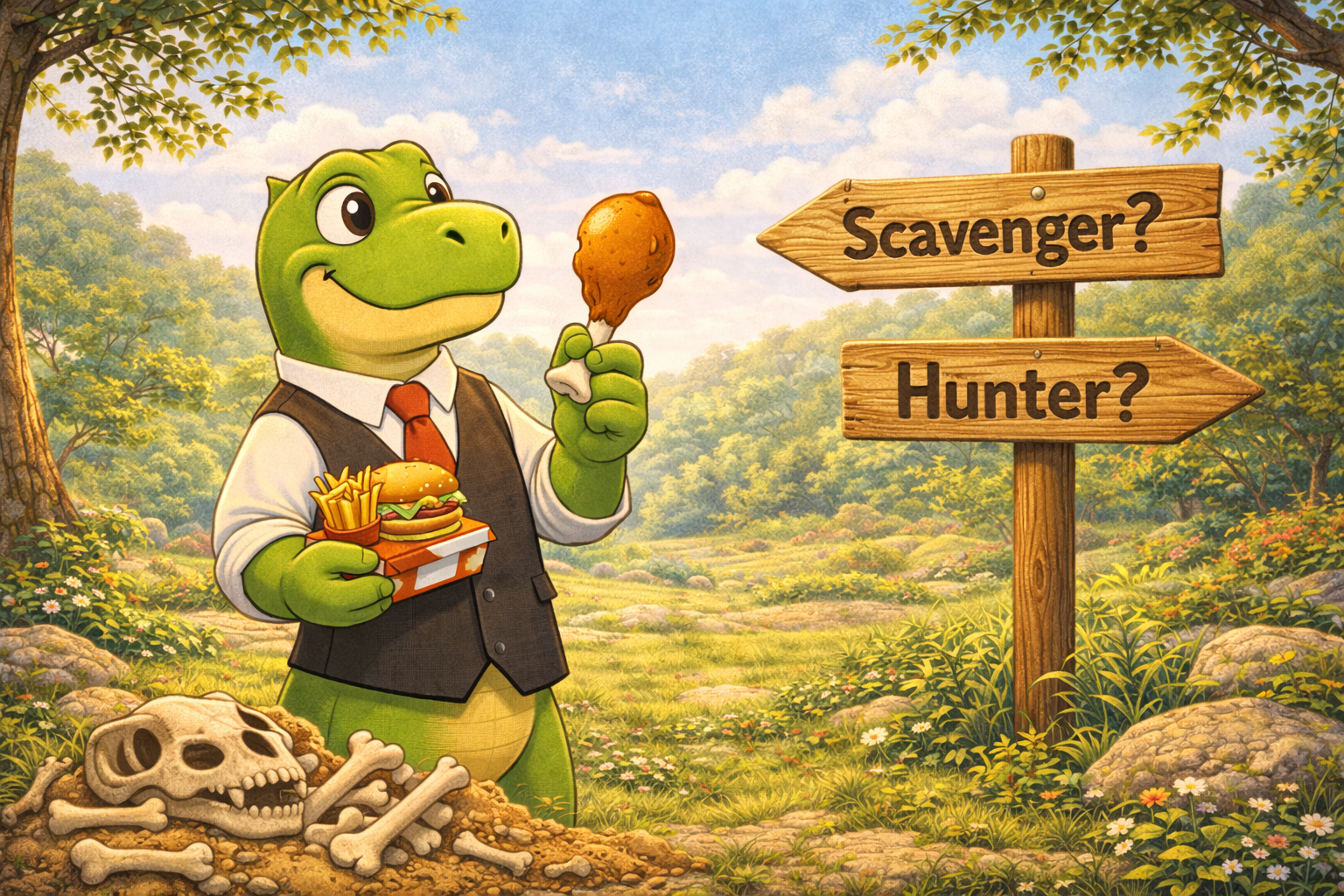
Was T. rex a Hunter… or the Dino Clean-Up Crew?
If you have ever debated this at the dinner table, you are in good company.
For years, scientists, dinosaur fans, and curious kids have argued one big question:
Was Tyrannosaurus rex a fearless hunter, or did it mostly show up late to the meal?
Let’s take a calm, fossil-friendly look at the evidence.
🔍 What the Fossils Tell Us
Some fossils carry bite marks that healed while the dinosaur was still alive. A few hadrosaur bones show deep wounds shaped exactly like T. rex teeth.
Healing matters.
It means the bite happened during life, not after death. That suggests T. rex attacked living animals and sometimes missed the finishing move.
Other fossils tell a different story. Some bones appear torn apart long after death, a sign of scavenging. A giant predator would not ignore an easy meal.
Free food counts in any era.
💪 Built for a Serious Bite
T. rex had one of the strongest bites ever measured in a land animal. Estimates put its bite force at more than 12,000 pounds.
That kind of power could crush bone, not just skin.
Its teeth were thick, curved, and edged like steak knives. Perfect for gripping, tearing, and holding onto struggling prey. Also perfect for breaking into an already-fallen carcass.
Those jaws worked well in more than one role.
🦵 Fast Enough to Matter
Some early ideas pictured T. rex as slow and clumsy. Newer research paints a sharper picture.
Biomechanical models show it could move at a solid walking pace and manage short bursts of speed, possibly up to 12–20 miles per hour. Not built for long chases, but fast enough to ambush or pressure injured animals.
Add sharp eyesight and an excellent sense of smell, and T. rex starts to resemble modern predators such as lions.
They hunt when it makes sense.
They scavenge when opportunity appears.
🤔 So Which One Was It?
Here is the simple answer.
Both.
T. rex likely hunted live prey and scavenged when meals came easily. Many successful animals do the same today. Bears, hyenas, and even wolves mix strategies depending on conditions.
That flexibility shows intelligence, not weakness.
Survival favors dinosaurs that waste less energy and take smart chances.
Like to Think?
Shop for brain-building toys for kids at Adventure Town Toys. #ad

👨👩👧👦 A Bronto-Style Question
Next time you head out for a walk, ask this:
“If you were a T. rex, would you chase dinner… or wait for a free meal?”
There is no wrong answer. The fun lies in the reasoning.
Science works best when curiosity leads the conversation.
Follow Our Tracks on Social Media
Thanks for visiting!
🦕Featured Article: Autism and Dinosaurs: A Slow Day in Brontobama
🦖 #brontobama # autism
More Fun With Dinosaurs
📚 Book Series #ad Amazon
🧢 Dinosaur Gift Shop #ad Etsy
🖍️ Free Coloring Page
📬 Contact
🐾 Doug Bayliss, Author and Creator — bayliss.com